Kurd - From Prototype to Foundation
Before the Kurd scale became the most recognizable scale in the handpan world, it didn’t even have a name.
But there were whispers.
At the time, the most common D minor scale on offer was the Integral Hang by Panart: D/ A Bb C D E F A. Missing the 4th—in this case, the G—meant it wasn’t the full expression of the scale, but rather a carefully chosen subset.
And yet, there were rumors.
I had heard that the full expression did exist, that Panart had made it at least once. Early Hang distributor Ron Kravitz had one—a rare eight-note second-generation Hang: D /A Bb C D E F G A. A few friends had played it and reported on the brilliance of the scale.
It stayed, however, in the shadows.
In October of 2011, on the handpan.org forums, Lauri Wuolio posted what is likely the first documented mention of the scale. Even then, he couldn’t quite pin it down:
“Here are two short demos of the Kurd/Phrygian/Zokuso scale… or Aeolian, if you consider the D ding as the base of the scale.”
Three names.
Four interpretations.
No consensus.
What he was describing wasn’t just a scale—it was something still in the process of becoming.
Earlier that year, Lauri traveled to see Victor, the maker of the famed SPB. He hadn’t gone there for Kurd. The plan was to buy a Japanese-inspired hexatonic instrument. That was the landscape at the time: carefully limited note sets, often six tones, designed to guide the player by removing choice. Panart’s Integral lived in that same philosophy, offering six or seven notes and an intentionally constrained experience.
But sitting in the workshop was something unfinished.
An early prototype. Eight notes. Not even glued together.
And yet, it changed everything.
“I found it so versatile compared to all the other hexatonics that I wanted it.”
That moment marks a quiet but decisive shift. Until then, the dominant philosophy of handpan design had been subtraction—less notes, more space, fewer decisions. But this instrument offered something else entirely: possibility.
So Lauri made a different kind of choice. He left payment behind and returned to Finland. Months later, Victor’s father delivered the instrument.
The first Kurd8 had entered the world.
D/ A Bb C D E F G A
Even in those early forum discussions, Lauri recognized what was happening:
“It's hard to think of a more versatile scale than this…”
That observation is easy to miss, but historically it marks the beginning of a transition from hexatonic limitation to diatonic expansion. The Kurd scale wasn’t just another layout. It was a step toward completeness.
Not long after, the scale evolved. David Kuckhermann received the first Kurd9, adding a high C and completing the upper extension of the scale. The reaction was immediate. It was a total game changer.
D/ A Bb C D E F G A C
This wasn’t just incremental improvement. It fundamentally changed how the instrument could function. Suddenly there were more melodic pathways, more harmonic implication, and more interpretive freedom. For the first time, a handpan scale began to move beyond a curated experience and behave like a musical system.
Scales don’t spread on their own.
People carry them.
They plant their flag so others can find it.
In 2012, I sold my second-generation Hang and traveled to Russia to see Victor. I had heard enough about this scale that I needed to experience it for myself. I came home with my own Kurd9 and began a relationship with it that continues more than a decade later.
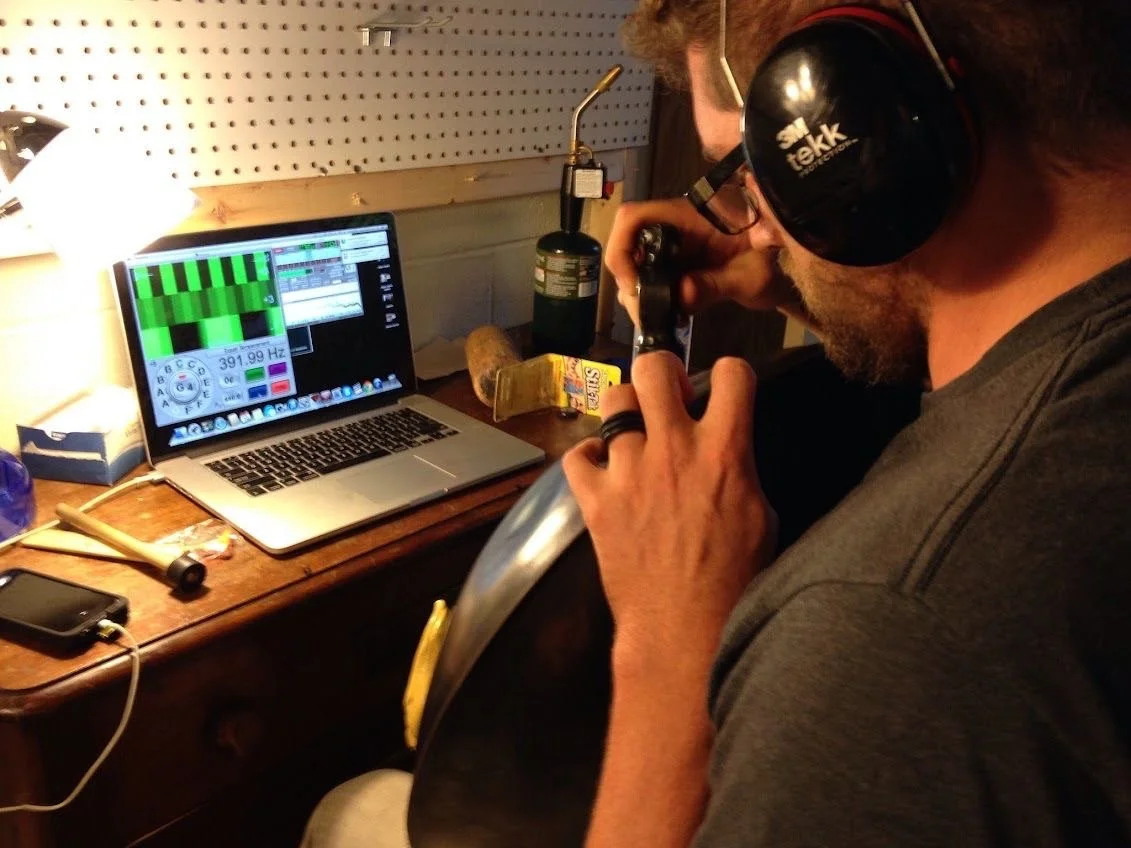
By 2014, the Kurd scale had begun to move beyond its origin. It was no longer confined to a single builder; it was entering the broader ecosystem. That year, I tuned both Lauri Wuolio’s Kurd8, the first of its kind, and David Kuckhermann’s Kurd9.
The originals.
There’s a different kind of understanding that comes from that. You’re not just tuning notes—you’re interacting with decisions that were made before the scale had a name, before it had theory, before it had consensus. You feel the spacing, the decisions, and the early ideas that eventually blossomed into a sound we now universally recognize.
There’s even a video from that time—Lauri’s instrument on the bench, partials moving across the screen, the quiet, deliberate work of bringing it back into alignment.
A long list of scales passed through the early handpan world. Some were beautiful, some were interesting, and most didn’t last. Kurd did.
Not because it was the most exotic, but because it was the most useful. It offered enough structure to guide beginners, enough depth to keep advanced players engaged, and enough consistency for builders to reproduce. Perhaps most importantly, it didn’t belong to one tradition.
And it didn’t stop evolving.
The next major expansion came not from adding higher notes, but from reaching downward.
With the emergence of the Kurd12, the scale opened in a new direction. By introducing the lower F and G as bottom notes, the instrument gained something it had always hinted at but never fully delivered: a true sense of chord progression and classical movement.
D/ [F] [G] A Bb C D E F G A C
Those lower tones changed how the scale could be felt. The instrument was no longer just melodic—it became expansive. The added depth allowed for bass movement, for tension and release, for phrases that didn’t just float but resolve. Where earlier versions of the Kurd scale invited exploration, the Kurd 12 allowed for structure within that exploration.
The scale that had once been defined by its versatility was now being defined by its range—not just in notes, but in emotional and musical possibility.
That evolution has continued.
My modern expression of that lineage is the Xenith Expanse Kurd17:
[Bb2] [C3] D3 | [F3] [G3] A3 Bb3 C4 D4 E4 F4 G4 A4 C5 D5 E5 F5
Seventeen notes spanning more than two octaves. Where the Kurd12 expanded downward, the Kurd17 pushes in both directions, extending the bass register below the Ding while adding D5, E5, and F5 above the original scale.
And yet, at its center is the same Kurd9 that started it all:
D3 | A3 Bb3 C4 D4 E4 F4 G4 A4 C5
The scale has grown dramatically, but its foundation hasn’t changed.
Today, the Kurd scale is often treated as a starting point, a baseline, the first instrument many players encounter. But that’s not how it began.
It began as a prototype that wasn’t finished, a name that wasn’t agreed upon, and a maker who was brave enough to take it on.
It became what it is because enough people—players, builders, and tuners—recognized something in it and carried it forward.
I just happened to be there as it all unfolded.